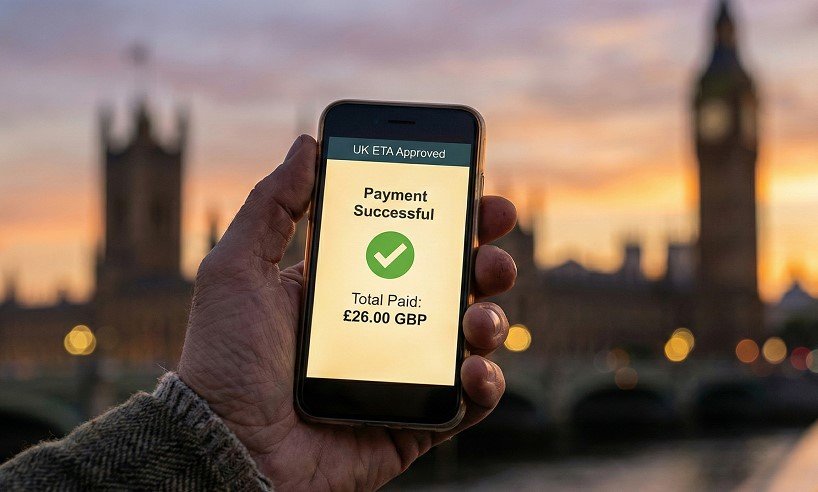
You have your passport ready. You have checked your eligibility. Now, you are at the final step: paying for your UK Electronic Travel Authorisation (ETA).
The official price tag says £26. But when you check your bank statement later, the amount is higher. Why the discrepancy?
For travelers from the UAE, Saudi Arabia, the US, or Europe, paying a fee in British Pounds (GBP) often triggers a chain of hidden banking costs. Between exchange rates, foreign transaction fees, and “dynamic” conversion traps, the final cost can be confusing.
This guide clarifies exactly what you are paying, how to avoid unnecessary bank charges, and how to ensure your payment goes through smoothly.
How Much Does the UK ETA Actually Cost? (Beyond the £26)
The UK Home Office has set the ETA fee at a fixed £26 GBP per applicant. This price is constant regardless of where you are applying from.
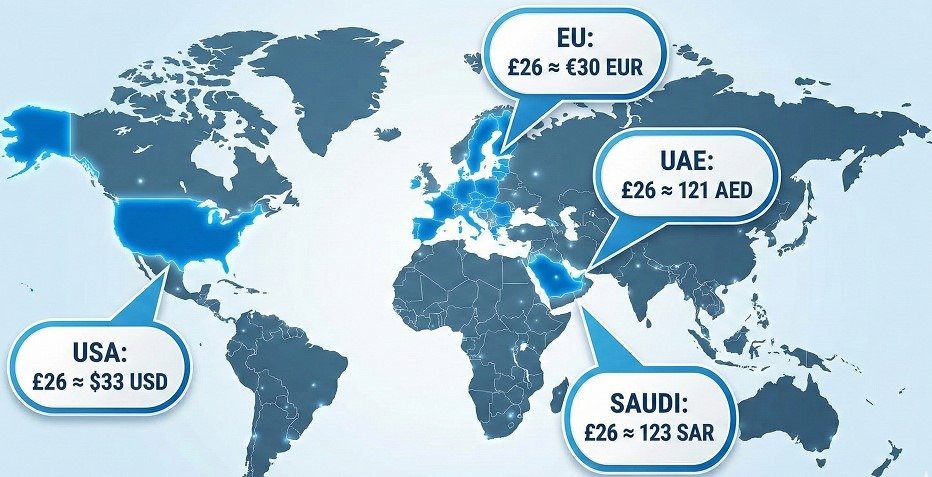
However, if your bank account is funded in Dirhams (AED), Riyals (SAR), Dollars (USD), or Euros (EUR), you are not just paying £26. You are paying the exchange rate at the exact moment of the transaction, plus fees.
The Breakdown of Your Final Bill
When you click “Pay,” three things happen:
- The Base Cost: £26 GBP.
- The Exchange Rate: Your bank converts your local currency to buy £26.
- The Foreign Transaction Fee: Most banks charge a standard fee (usually 1% to 3%) for processing international payments.
Can I Pay the UK ETA Fee in My Local Currency?
Technically, no. The UK government charges the fee strictly in British Pounds.
However, practically, yes. You do not need a GBP bank account to apply. You can use your local credit or debit card (Visa, Mastercard, Amex). Your card issuer handles the currency swap automatically.
Here is the catch: You do not control the exchange rate used. The rate is determined by the card network (like Visa or Mastercard) and your specific bank policies.
Avoid the “Dynamic Currency Conversion” (DCC) Trap
This is the most common mistake travelers make. It happens when a payment portal or card terminal asks: “Would you like to pay in GBP or your home currency (e.g., USD/AED)?”
It feels convenient to see the price in your own money. Do not do it.
This is called Dynamic Currency Conversion (DCC). If you choose your home currency, the merchant (or payment processor) sets the exchange rate, which is almost always terrible. They often add a hefty markup.
comparison: Paying in GBP vs. Paying in Home Currency (DCC)
| Feature | Option A: Pay in GBP (Recommended) | Option B: Pay in Home Currency (DCC) |
| Who Converts? | Your Bank / Card Issuer | The Payment Gateway / Merchant |
| Exchange Rate | Near market “mid-point” rate | Inflated rate (often +3-5% markup) |
| Transparency | You see the final cost on your statement later | You see the cost immediately, but it is higher |
| Hidden Fees | Standard bank transaction fee (if any) | Built-in conversion markup + potential bank fee |
| Verdict | Best Value | Avoid |
Accepted Payment Methods for UK ETA
To ensure your application is processed instantly, you need a valid electronic payment method. The system is designed for speed and digital access.
Accepted methods currently include:
- Credit & Debit Cards: Visa, Mastercard, American Express, and Discover.
- Digital Wallets: Apple Pay and Google Pay.
Pro Tip: Apple Pay and Google Pay are excellent options. They often provide an extra layer of biometric security (FaceID/TouchID), which reduces the chance of your bank flagging the transaction as “suspicious” simply because it is an overseas charge.
Why Was My Payment Declined? Common Banking Errors
Few things are more frustrating than a declined payment when you are trying to finalize travel plans. If your UK ETA payment fails, it is rarely a technical issue with the website. It is usually your bank protecting you.
Common triggers for declined payments:
- International Lock: Many cards have a default block on foreign transactions to prevent fraud. Check your banking app to ensure “International Spending” is turned on.
- Suspected Fraud: A sudden small charge in the UK can look suspicious to a bank algorithm in Saudi Arabia or the US.
- Incorrect Billing Address: The address you enter on the payment screen must match the address on your bank file exactly.
The Benefit of Applying via etauk.ae
Navigating government portals, handling currency confusion, and risking rejected applications can be stressful.
At https://etauk.ae/, we simplify the entire process for you. We review your submission to ensure it meets all UK Home Office standards before it is processed. This reduces the risk of rejection and the hassle of dealing with refunds or re-applications.
Whether you are traveling for tourism, business, or visiting family, our team ensures your authorization is sorted so you can focus on packing your bags.
Frequently Asked Questions (FAQ)
How much is the UK ETA fee in my local currency?
The base fee is approx £26 GBP.
The exact amount in your currency depends on the daily exchange rate. Always check the latest rates before applying.
Will I be charged extra fees when paying for the UK ETA?
Yes, likely by your bank.
While the government fee is fixed, your bank may charge a Foreign Transaction Fee (typically 1-3%). You can avoid higher costs by declining “Dynamic Currency Conversion” at checkout.
Why was my UK ETA payment declined?
Usually due to bank security blocks.
Banks often flag foreign transactions to prevent fraud. Ensure your card is unlocked for international usage and that you have sufficient funds to cover the fee plus the exchange buffer.
Can I pay for the UK ETA with cash?
No, the system is 100% digital.
You must use a credit card, debit card, Amex or digital wallet like Google Pay. There is no option to pay via cash, check, or bank transfer at an embassy.
Is the UK ETA fee refundable if my application is denied?
Generally, no.
The fee covers the cost of processing your application, not just the approval. If rejected, the fee is usually not returned. This is why using a review service like etauk.ae is valuable to prevent errors.